Article prepared by MedPAN and SPA/RAC
9% of the Mediterranean Sea currently benefits from protected status. With less than five years to go until the deadline for the target to protect 30% of the Mediterranean’s coastal and marine areas by 2030 – as set out in the Post-2020 Regional Strategy for Marine and Coastal Protected Areas (MCPAs) and Other Effective Area-based Conservation Measures (ECMs) in the Mediterranean – adopted by the Barcelona Convention and aligned with Target 3 (30×30) of the Convention on Biological Diversity (CBD), the 2025 Status of Marine Protected Areas in the Mediterranean helps to accurately measure progress made and the challenges that remain.
A solid foundation, built up over 70 years
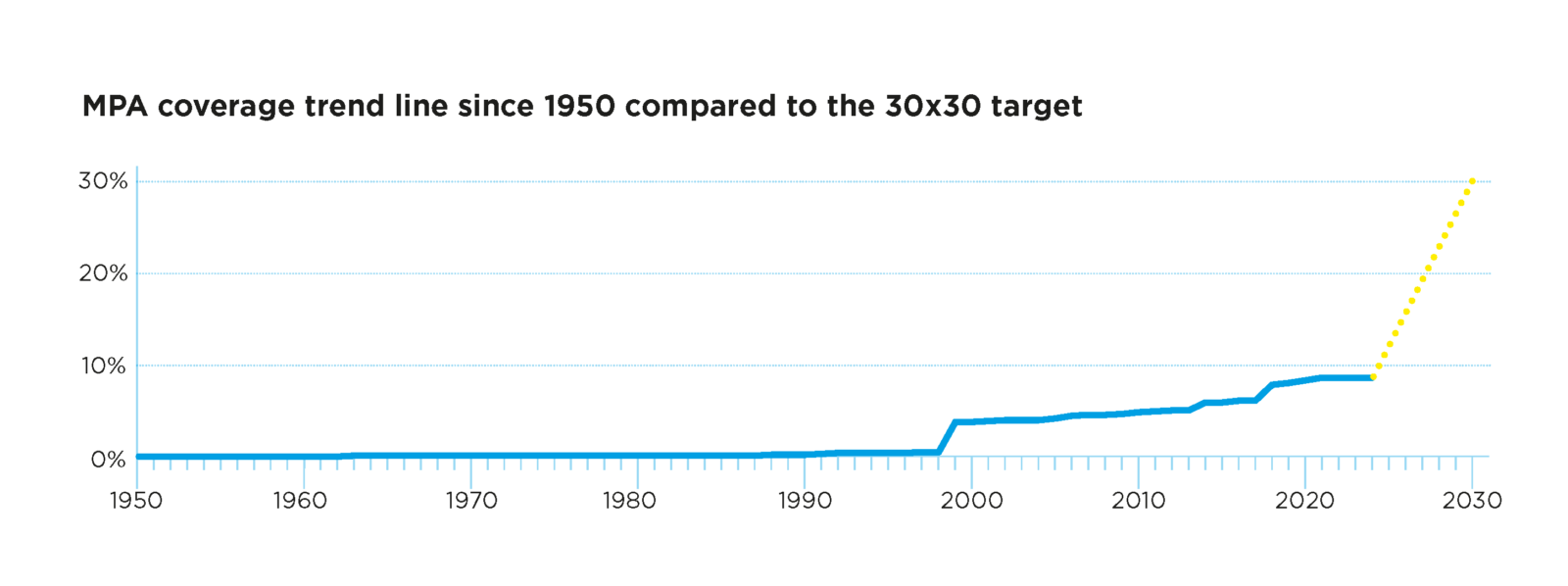
By the end of 2024, the Mediterranean counted 1,152 officially designated Marine Protected Areas (MPAs), covering 225,163 km², or 9.0% of the basin. Behind this single figure lie distinct legal realities: 282 MPAs with national status (80,231 km², 3.2%), 869 Natura 2000 marine sites (97,251 km², 3.9 per cent), 39 Specially Protected Areas of Mediterranean Importance (SPAMI) under the Barcelona Convention (138,464 km², 5.5 per cent), and one international agreement, the Pelagos Marine Mammal Sanctuary (87,625 km², 3.5 per cent). This architecture was developed gradually, in line with changes to the regulatory framework: the first national MPA in the 1950s, the first marine Natura 2000 sites in the late 1980s, the creation of the Pelagos Sanctuary in 1999 (a single leap representing a significant increase in coverage), successive waves of designations in the northern Mediterranean, and, more recently, the Cetacean Migration Corridor in Spain.
Major gaps
Real progress has been made. However, when measured against the ‘30×30’ target – to protect 30 per cent of the Mediterranean’s marine and coastal areas by 2030 – this progress still seems insufficient given the timeframe.
30×30, what is it?
This is the commitment made by the Parties to the Convention on Biological Diversity with the adoption, in 2022, of the Kunming–Montreal Global Biodiversity Framework, and more specifically its Target 3, which aims to ensure that, by 2030, at least 30% of terrestrial areas, inland waters, and coastal and marine areas are effectively conserved and managed, particularly those areas of particular importance for biodiversity and ecosystem functions and services, through protected area systems and other effective area-based conservation measures that are ecologically representative, well-connected and equitably governed.
The 30×30 initiative therefore does not focus only on the area covered, but also on the effectiveness of the conservation and management of the areas concerned.
In the Mediterranean, this objective is notably reflected in the post-2020 Regional Strategy for Marine and Coastal Protected Areas (MCPAs) and other area-based effective conservation measures (AECMs), adopted by the Parties to the Barcelona Convention in 2021, and the European Union’s Biodiversity Strategy for 2030.
This is the commitment made by the Parties to the Convention on Biological Diversity with the adoption, in 2022, of the Kunming–Montreal Global Biodiversity Framework, and more specifically its Target 3, which aims to ensure that, by 2030, at least 30% of terrestrial areas, inland waters, and coastal and marine areas are effectively conserved and managed, particularly those areas of particular importance for biodiversity and ecosystem functions and services, through protected area systems and other effective area-based conservation measures that are ecologically representative, well-connected and equitably governed.
The 30×30 initiative therefore does not focus only on the area covered, but also on the effectiveness of the conservation and management of the areas concerned.
In the Mediterranean, this objective is notably reflected in the post-2020 Regional Strategy for Marine and Coastal Protected Areas (MCPAs) and other area-based effective conservation measures (OECMs), adopted by the Parties to the Barcelona Convention in 2021, and the European Union’s Biodiversity Strategy for 2030.
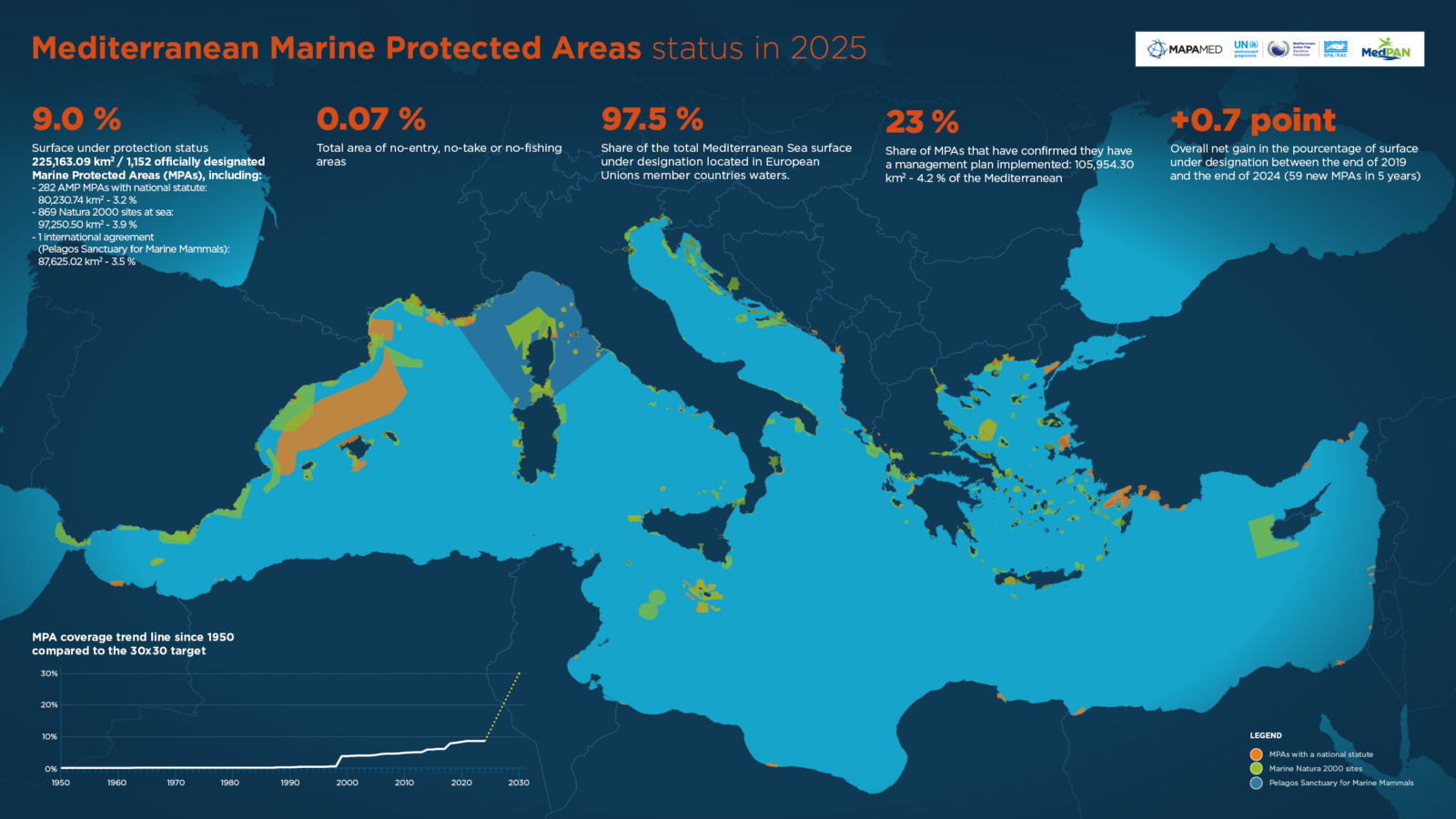
However, focusing solely on surface area would be a misinterpretation. By cross-referencing MAPAMED’s spatial data with responses from 263 MPAs as part of the consultation carried out for the 2025 Status of Mediterranean MPAs (due to be published in late 2026), the report shows that the gap with the 30×30 target is played out simultaneously on five levels: the pace of designation, the level of protection, the uneven geographical distribution, the reality of management, and the ecological representativeness of the network.
A slow designation process
Between the end of 2019 and the end of 2024, the total area under protection increased by just 0.7 percentage points, with 59 new MPAs established over the five-year period.
At this rate, the Mediterranean would not reach 30% for another 150 years. This projection is not intended to predict the future, but it can serve as a benchmark. It suggests that simply continuing with current trends will not lead to the 30×30 target being met, and that achieving the target requires a significant shift in the scale of conservation decisions, particularly in offshore and open-sea areas.
Under-representation of fully protected areas
Protected status does not necessarily mean that all pressures are reduced. Fully protected areas (no-access, no-take or no-fishing) account for just 0.07% of the Mediterranean.
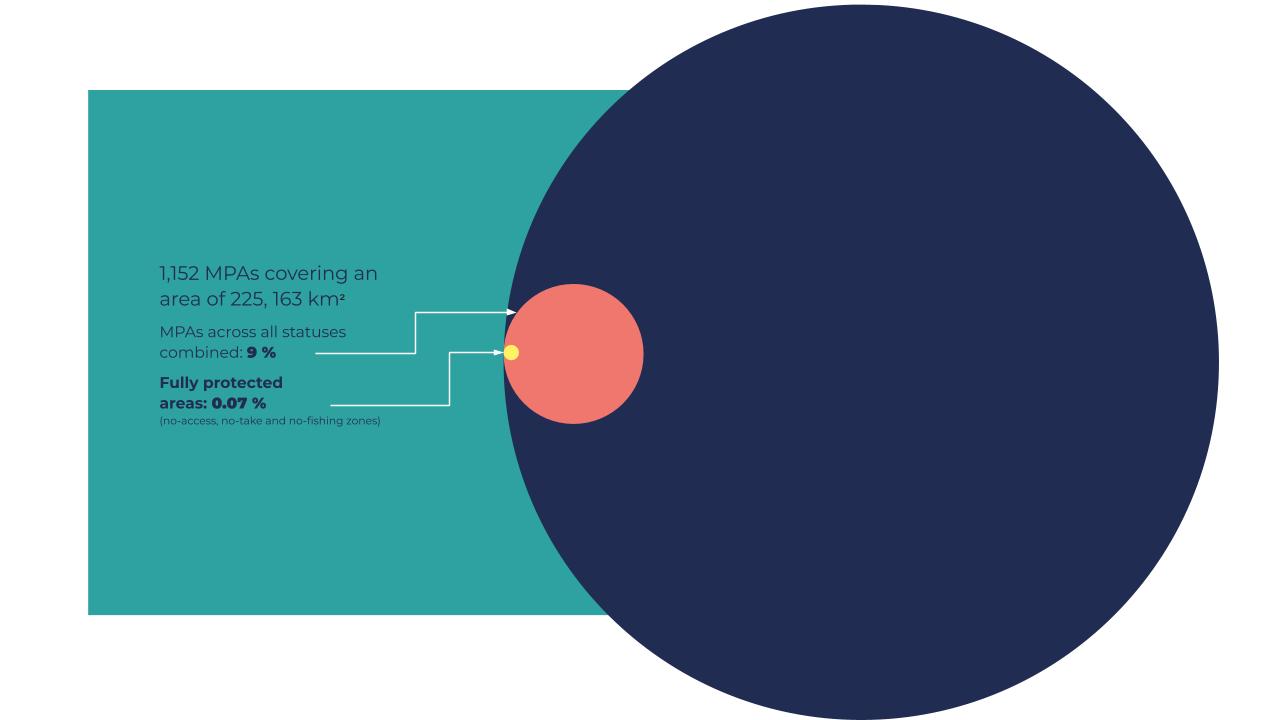
And yet these are areas that produce the best-documented ecological effects: biomass recovery, the reserve effect, and spillover into adjacent fishing grounds. A credible pathway towards 2030 cannot, therefore, be limited to simply adding up designated areas: it must significantly increase the proportion of the network under full protection.
An uneven geographical distribution
97.5% of the designated area lies on the northern shore of the Mediterranean. In terms of area, the Mediterranean network therefore shows a marked imbalance in favor of the northern shore, with coverage on the southern and eastern shores still significantly more limited.
This imbalance is not just a minor issue: it undermines the ecological coherence of the whole. Mobile species, migratory corridors and larval connectivity do not stop at jurisdictional boundaries. An ecologically representative and connected network requires strengthening the designation and management resources on the southern and eastern shores of the basin, one of the key challenges for regional cooperation under the Barcelona Convention.
From designation to effective management: numerous challenges
These are the most innovative aspects of the report : based on a survey of 263 MPAs, representing approximately 23% of all MPAs in the Mediterranean.
The result is clear: 23% of these MPAs confirm that they have a management plan in place, which, in terms of area, corresponds to 4.2% of the Mediterranean. In other words, the area actually covered by an operational management framework represents less than half of the designated area.
An analysis of twelve conditions enabling effective management, drawn from the scientific literature (Hockings et al., 2006; Gill et al., 2017; Geldmann et al., 2019.), and assessed by managers, clarifies the picture. The three factors identified as being most critical to achieving management objectives – staff, regulations, and stakeholder involvement and cooperation – all received a rather negative assessment. Funding, equipment, monitoring and scientific follow-up are also viewed in a similarly negative light.
The report also highlights a lack of resources: on average, one management unit oversees six MPAs, with a median of three, and up to 67 MPAs were reported by a single organisation in the survey. The more sites a unit manages, the less likely those sites are to meet their objectives.
Low ecological representativeness
Mediterranean MPAs protect a wide variety of habitats, but with a clear predominance of coastal and shallow habitats. Posidonia seagrass beds and coralligenous communities are the best-monitored habitats; deep-water ecosystems and coastal wetlands remain under-represented and inadequately monitored. At the species level, the coverage of areas of conservation importance by MPAs is encouraging for certain taxa (e.g. birds and turtles) but remains insufficient for others, such as marine mammals and elasmobranchs.
Ecosystems under increasing pressure
In the current context, human pressures are intensifying. Taking into account both intensity and frequency of occurrence, the report ranks mooring, motorised water sports and small-scale fishing as the leading pressure factors, ahead of recreational fishing, diving, swimming and coastal development. In other words, the dominant pressures stem from recreational, tourist and small-scale coastal fishing activities, which are usually authorised or subject to limited regulation within MPAs.
Added to this are two widespread pressures: pollution, with marine litter by far the most commonly reported nuisance; and invasive alien species, the severity of which follows a clear east–west gradient (8% of MPAs report high pressure across the basin as a whole, compared with 53% in the Aegean–Levant region).
A shared dashboard and a meeting
This assessment would not have been possible without MAPAMED, the database of marine protected areas in the Mediterranean, developed and managed jointly by SPA/RAC and MedPAN, and validated by the SPA/BD Focal Points of the Barcelona Convention. A new version, featuring additional site-specific fact sheets, will be available shortly. It is this version that will enable us to monitor over time and compare between countries the actual progress made towards 2030.
What happens next depends on collective action. The findings of the 2025 Status Report (to be published in late 2026) will directly inform the 4th Mediterranean Marine Protected Areas Forum, to be held from 15 to 17 December 2026 in Alexandria, an event at which managers, representatives of national authorities and administrations responsible for MPAs, scientists and donors will discuss findings, share solutions and agree on priorities.
Submit your application to participate in the Forum (deadline on 23 October 2026) !